


 KO
 JP
 CN
 TH
 VN
 MG
Speculum Examination: Types, Procedure, and Pain Management
Discomfort during a speculum examination can be influenced not only by the size of the speculum but also by the angle of insertion,
the degree of opening, and the removal process. Selecting an appropriate speculum based on the patient's anatomy
and examination needs, and opening it slowly and only as much as necessary, can help minimize discomfort.
One of the most common concerns women have before visiting a gynecologist is the fear of pain or discomfort during a speculum examination.
For women undergoing their first gynecological examination, or those who have previously experienced discomfort,
the procedure itself may feel particularly intimidating.
In fact, some patients become nervous when they see a vaginal speculum in the examination room because of its unfamiliar shape or unexpectedly large appearance. However, a speculum is a basic gynecological instrument used to examine the vaginal walls and cervix.
Today, as an OB-GYN specialist, I would like to explain why speculum examinations are necessary,
the different types of vaginal speculums, and the important factors that can help reduce discomfort during the examination.
1. What Is a Speculum Examination?
A speculum examination is a gynecological procedure in which an instrument called
a vaginal speculum is gently inserted into the vagina to allow direct visualization of the vaginal walls and cervix.
In gynecological practice, speculums are used for various purposes,
including collecting vaginal discharge samples and examining the condition of the cervix.
This is because the internal structures of the vagina and cervix cannot be adequately evaluated through external observation alone.
For example, directly examining the cervix may be necessary to identify cervical polyps, wart-like lesions, or other abnormalities.
During the examination, the speculum is carefully inserted and opened only as much as necessary to visualize the area.
In other words, a vaginal speculum is an instrument designed to help healthcare professionals examine the vaginal canal and cervix, and it should be used appropriately according to the purpose of the examination.
2. Types and Sizes of Vaginal Speculums
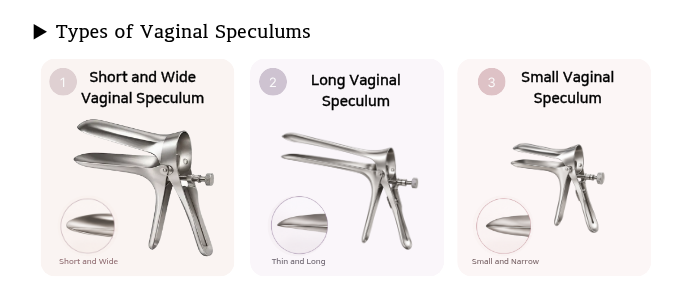
Vaginal speculums come in various sizes, lengths, and shapes.
Different types may be selected depending on the purpose of the examination, the depth of the vaginal canal, and the area that needs to be examined.
1) Short and Wide Vaginal Speculum
A short and wide vaginal speculum typically has a shape resembling a duck's bill.
Its handle is positioned below the blades, and its relatively short, wide design can provide a broader view of the vaginal canal.
This type of speculum can be particularly useful when a wider opening is needed to examine internal structures or perform certain gynecological procedures.
2) Long Vaginal Speculum
A longer vaginal speculum may be used when the vaginal canal is relatively deep or when a clearer view of the cervix is required.
It can be especially useful in situations where the cervix needs to be thoroughly visualized, such as during cervical imaging or photography.
3) Small Vaginal Speculum
At Gangnam Daum Women's Clinic, the type of speculum we most frequently use is a small-sized vaginal speculum.
We generally prefer speculums that are smaller than the width of two fingers.
Although certain examinations require a wider view of the vaginal canal,
many examinations can be performed adequately using a smaller speculum.
By opening the speculum only as much as necessary and adjusting its direction during the examination, it is often possible to visualize the required structures without excessive widening.
3. What Causes Pain During a Speculum Examination?
Pain or discomfort during a speculum examination is not determined solely by the size of the instrument.
A vaginal speculum has two blades that can be opened to allow visualization of the vaginal canal and cervix.
Although the instrument is designed to open to a considerable width, it does not need to be opened fully during every examination.
Opening the speculum wider than necessary or suddenly expanding the blades immediately after insertion may cause pain or discomfort.
Another important factor is the individual anatomy of the vaginal canal.
The direction of the vaginal canal can vary from person to person.
Rather than being a perfectly straight, cylindrical passage, the vaginal canal may have a slight curve or a different angle depending on the individual's anatomy.
If the speculum is inserted without considering these anatomical differences, the patient may experience increased discomfort.
Therefore, during a speculum examination, it is important to consider each patient's anatomical structure and carefully adjust the angle of insertion and degree of opening while examining the internal structures.
4.Three Important Ways to Reduce Pain During a Speculum Examination
Discomfort during a speculum examination may vary not only according to the type of instrument used but also depending on how the healthcare professional handles it.
In my clinical practice, I consider the following three factors particularly important.
1) Gentle Insertion Based on the Direction of the Vaginal Canal
The length and direction of the vaginal canal vary among individuals.
Therefore, when inserting a speculum, it is important to consider the patient's anatomical structure and proceed slowly at an angle that minimizes discomfort. Rather than inserting the instrument forcefully, gentle insertion along the natural direction of the vaginal canal may help make the examination more comfortable.
2) Opening the Speculum Slowly and Only as Much as Necessary
Once the speculum has been inserted, the blades should be opened only enough to allow adequate visualization.
Instead of opening the instrument widely from the beginning, the degree of opening can be gradually adjusted according to the examination requirements. In some cases, a smaller speculum can be used while carefully adjusting its direction to examine the necessary areas.
3) Gentle Removal While Avoiding Excessive Pressure Toward the Urethra
Excessively lifting the speculum toward the urethra may cause discomfort.
Therefore, when removing the instrument, it is important to avoid unnecessary pressure toward the urethral area.
The speculum should be gently closed and slowly withdrawn while taking care not to pinch the surrounding tissues.
These careful techniques may help reduce pain and discomfort during the examination.
[At Gangnam Daum Women's Clinic], we strive to perform speculum examinations with careful consideration of each patient's anatomy and the purpose of the examination. We select an appropriately sized speculum and pay close attention to every step of the procedure, from insertion and internal examination to removal.
When a smaller speculum is suitable, we aim to avoid unnecessary widening and perform the examination using only the degree of opening required. We believe that paying attention to a patient's comfort throughout the examination is just as important as obtaining an accurate assessment.
Even if you feel nervous or anxious about visiting a gynecologist, we encourage you not to postpone necessary routine gynecological examinations, as they play an important role in protecting your reproductive health.
