


 KO
KO JP
JP CN
CN TH
TH VN
VN MG
MGCystoscopy & Hysteroscopy: Methods and Conditions
Cystoscopy examines the bladder, while hysteroscopy examines the uterine cavity
for abnormalities such as polyps, inflammation, adhesions, and fibroids.
Today, I would like to explain the new endoscopic equipment that has recently been introduced at our clinic.
In gynecological practice, there are cases where it can be difficult to accurately assess internal conditions through a routine outpatient examination alone. For example, in patients with chronic cystitis, blood or inflammatory markers may repeatedly be detected in urine tests, but it may still be difficult to determine exactly what is happening inside the bladder.
In such cases, a cystoscope can be inserted into the bladder to directly examine its interior.
It is similar to the way an upper gastrointestinal endoscopy is used to directly examine the inside of the stomach.
With cystoscopy, we can directly observe the inner wall and lining of the bladder.
1. Cystoscopy Allows Direct Examination of the Inside of the Bladder
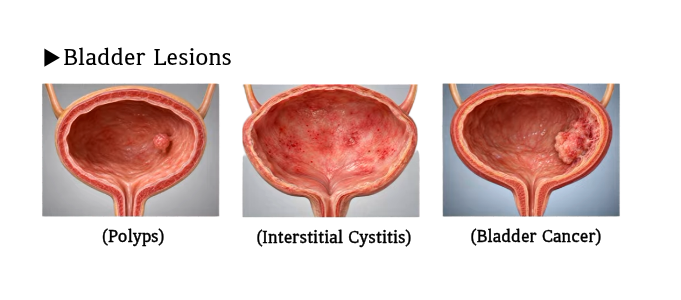
Using a cystoscope, we can directly examine the condition of the bladder lining.
During the examination, we can check for polyps, areas where the bladder lining appears weakened, signs suggestive of interstitial cystitis,
and, although rare, abnormalities such as bladder cancer.
For this reason, we have introduced new endoscopic equipment to allow us to examine the inside of the bladder more directly,
make a more accurate assessment, and provide more precise treatment when necessary.
2. The Bladder Can Also Be Examined During Urinary Incontinence Evaluation and After Surgery
In some cases, internal conditions also need to be evaluated when diagnosing urinary incontinence.
Cystoscopy can be used to check the bladder lining and look for any abnormalities,
as well as to directly assess the condition of the tissues inside the bladder.
It may also be used as part of an evaluation for urinary incontinence.
After urinary incontinence surgery, cystoscopy may also be used to check whether the *mesh is properly positioned and
whether there are any other abnormalities.
*Mesh: An artificial tape-like material placed around the urethra to provide support during certain urinary incontinence procedures.
3. Hysteroscopy Allows Direct Examination of the Inside of the Uterus
Then how can we examine the inside of the uterus?
A conventional speculum examination allows the vagina and the surface of the cervix to be observed,
but it is difficult to directly examine the inside of the uterus.
When it is necessary to determine whether there are polyps or other abnormalities inside the uterus,
a hysteroscopic examination may be considered.
With a hysteroscope, the scope can be advanced through the natural passage into the uterine cavity,
allowing the inside of the uterus to be directly examined.
Because the vaginal passage is not completely straight,
an instrument that can move smoothly along its natural curve is needed to reach the uterine cavity.
A hysteroscope is designed to pass gently through the passage and allow a more detailed examination of the uterine cavity.
The endoscope is inserted and gradually advanced while the inside of the uterus is examined.
Its direction can be adjusted to carefully inspect different areas of the uterine cavity.
Abnormal bleeding areas, polyps, adhesions, uterine fibroids, and other abnormal findings can be identified.
One of the advantages of hysteroscopy is that it allows the doctor to directly visualize the inside of the uterus and more accurately determine where an abnormality may be present.
4. When May Hysteroscopy Be Considered?
Hysteroscopy may be considered when a detailed evaluation of the uterine cavity is necessary.
For example, it may be considered in cases of:
- Persistent vaginal bleeding
- Abnormal uterine bleeding
- Recurrent irregular menstrual cycles
- A suspected mass or lesion inside the uterus
In these situations, hysteroscopy can help directly examine the uterine cavity and
investigate possible causes of abnormal bleeding or menstrual irregularities.
Even when the exact cause has been difficult to determine through routine examinations, directly visualizing the uterine cavity with an endoscope can provide a more detailed assessment of the current condition.
Frequently Asked Questions FAQ
Q. Are cystoscopy and hysteroscopy painful? What can I expect?
A. Because the endoscopes used for these examinations are thin and flexible,
the level of discomfort may be less than many patients expect.
However, the degree of discomfort or pain can vary from person to person.
Q. How are cystoscopy and hysteroscopy different from a regular gynecological examination?
A. A conventional speculum examination is primarily used to examine the vagina and the surface of the cervix.
Hysteroscopy, on the other hand, uses an endoscope to directly visualize the inside of the uterus and can be used to identify abnormalities such as polyps, bleeding areas, and adhesions.
At Gangnam Daum Obstetrics & Gynecology, we have introduced cystoscopy and
hysteroscopy equipment to provide more accurate diagnoses and more detailed treatment for our patients.
When direct examination of the bladder is necessary, cystoscopy can be used to evaluate the bladder lining and
the condition of the bladder interior. When examination of the uterine cavity is needed,
hysteroscopy can be used to directly observe the inside of the uterus.
