


 KO
KO JP
JP CN
CN TH
TH VN
VN MG
MGWhen Is Labiaplasty Necessary? Causes and Surgical Criteria
Labial hypertrophy is influenced by genetics and hormonal changes, not sexual activity. Labiaplasty is considered based on physical discomfort, including friction, pain, and hygiene difficulties, rather than size alone.
When people hear about labiaplasty, many still assume that it is a procedure performed simply to improve the appearance of the genital area. Some even mistakenly believe that the labia become enlarged or stretched because of frequent sexual intercourse.
However, when listening to patients who visit our clinic to discuss labiaplasty, we often find that they have been experiencing a wide range of physical discomforts.
Today, I would like to address some common misconceptions about labiaplasty and explain why women consider this procedure, what causes labial hypertrophy, and how we determine whether surgery may be appropriate.
1. Is Labiaplasty Performed Only for Cosmetic Reasons?
The female external genitalia consist of the outer labia majora and the inner labia minora. The clitoris is located near the upper portion of the labia minora and is usually covered by the clitoral hood.The labia minora are relatively thin folds of tissue located inside the labia majora. Their size and shape naturally vary from person to person.
Because the labia majora contain fuller tissue, they often surround the labia minora when a woman is standing.
However, when the labia minora are enlarged or elongated, they may protrude beyond the labia majora. When this happens, friction from tight clothing or jeans can cause discomfort during everyday activities.
Despite these physical concerns, some people still assume:
"Isn't labiaplasty just about making the area look prettier?"
"Isn't it something women do because of their sex lives?"
Surprisingly, even parents or partners may not fully understand the discomfort experienced by women with enlarged labia minora.
In reality, many patients who visit our clinic have experienced physical discomfort since childhood.
Some teenage patients in their late teens also visit our clinic with their parents because of persistent discomfort.
For many women seeking labiaplasty, the primary concern is not cosmetic appearance but functional discomfort that affects their daily lives.
2. Everyday Discomfort Caused by Labial Hypertrophy
When the labia minora protrude significantly beyond the labia majora, they can cause more difficulties than many people realize.
First, protruding labial tissue may create a visible bulge through clothing.
Some women find themselves repeatedly adjusting their clothes without even realizing it.
This can become particularly uncomfortable when wearing tight-fitting pants, as the protruding tissue is continuously exposed to friction.
When the labia minora extend beyond the labia majora, sitting may also cause pressure and discomfort.
Similar to the uncomfortable sensation that develops when your legs remain bent for too long, prolonged pressure on the labial tissue may lead to pain or irritation.
In addition, when not only the labia minora but also the surrounding skin folds or clitoral hood are enlarged, maintaining hygiene can become more difficult.
Secretions may accumulate between the folds of skin, and some women experience changes in the direction of their urine stream, occasionally causing urine to run down toward their thighs.
Some patients even describe manually folding or tucking the protruding labia inward to prevent them from extending outside the labia majora.
Discomfort may also occur during sexual intercourse.
If the labial tissue is particularly thin or delicate, it may fold inward during penetration, causing pain. In more severe cases, repeated friction and irritation can lead to inflammation or swelling, sometimes prompting patients to seek urgent medical attention.
These repeated experiences of friction, irritation, inflammation, and discomfort are often what eventually lead women to consider labiaplasty.
3. Are Enlarged or Darkened Labia Caused by Sexual Activity?
As women age, the labial tissue may gradually change in elasticity, shape, and pigmentation. Unfortunately, some women receive hurtful or negative comments from their partners about these natural physical changes.
Such experiences can affect their confidence during intimacy, and in some cases, women may begin avoiding sexual intercourse altogether.
I have also had patients tell me:
"Doctor, I think my labia became stretched because I masturbated too much."
However, I want to emphasize one important point.
Labial hypertrophy is not proportional to the frequency of sexual intercourse.
The size and shape of the labia minora are strongly influenced by congenital and individual anatomical factors.
Hormonal changes during puberty can also contribute to the growth and development of the labial tissue.
Although external irritation may sometimes contribute to tissue changes, it is incorrect to conclude that enlarged labia are necessarily caused by sexual activity.
A woman's sexual history cannot be determined by the size, shape, or color of her labia.
This is an important misconception that I hope more people will understand.
4. What Are the Criteria for Labiaplasty?
When the labia minora protrude significantly beyond the labia majora and remain visible even when the legs are together, they may be considered relatively enlarged.
However, having larger labia minora does not automatically mean that surgery is necessary.
What matters most is whether the patient experiences discomfort in everyday life.
For example, we consider whether the labia rub against clothing, cause discomfort during exercise, or create pressure and pain when sitting for long periods or riding a bicycle. If there is no significant discomfort in daily life, surgery may not be necessary.
There is currently no single universally accepted five-grade classification system for labial hypertrophy.
At our clinic, we use an approximate five-grade classification to help patients better understand their condition.
The complexity of surgery may vary depending not only on how far the labia protrude but also on tissue thickness and the condition of the surrounding anatomical structures.
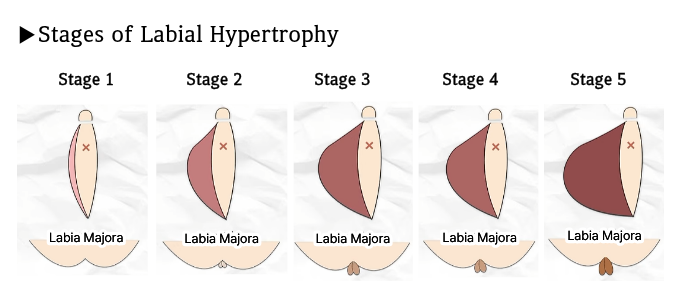
Grade 1: Mild Labial Protrusion
The labia minora extend slightly beyond the labia majora.
At this stage, surgery is generally not actively recommended.
Depending on the patient's symptoms, non-surgical care and management may be considered to relieve discomfort.
Grade 2: Moderate Labial Enlargement
The labia minora protrude more noticeably than in Grade 1.
Patients may begin to feel that something is touching or pressing against the area when sitting.
From this stage, surgery may be considered depending on the degree of discomfort experienced by the patient.
Grade 3: Significant Protrusion and Folding
The labia minora become more enlarged and visibly protrude beyond the labia majora.
When the tissue is particularly thin, it may fold inward, potentially causing irritation or discomfort.
Grade 4: Increased Labial Size and Thickness
The labia minora are substantially enlarged, and the tissue may also become thicker. Some patients describe a sensation similar to having something constantly caught or pressed between the surrounding tissues.
This may cause persistent pressure or discomfort.
Grade 5: Severe Labial Elongation and Sagging
The labia minora become significantly elongated and may hang downward.
Patients may experience a dangling or pulling sensation during movement, along with friction against the inner thighs.
In some cases, patients visit our clinic with labial enlargement that is even more pronounced than what we describe as Grade 5.
Interestingly, some women live with significant discomfort for many years before finally seeking medical advice in their 30s or 40s.
Because concerns about the genital area are not always easy to discuss with others, many women are unsure whether their anatomy is within the normal range or whether their symptoms warrant medical attention.
5. Will Labiaplasty Reduce Sexual Sensation?
One of the most frequently asked questions among women considering labiaplasty is:
"Will I lose sexual sensation after surgery?"
"Could the area become overly sensitive instead?“
These concerns are particularly common among parents who accompany their teenage daughters to consultations.
The clitoris contains a dense network of sensory nerves and plays an important role in sexual sensation.
Therefore, when performing labiaplasty, it is essential to carefully plan the incision lines while considering the location and course of the surrounding nerves.
During surgery, I sometimes use a surgical scalpel in certain areas to help minimize unnecessary thermal injury to nearby tissues.
It is also important to minimize tissue damage during incision closure and suturing.
I pay close attention to postoperative care to support healthy tissue healing and recovery.
However, it would be inaccurate to claim that changes in sensation can never occur after labiaplasty.
Temporary or persistent changes in sensitivity are possible, and the degree of risk may vary depending on the surgical technique,
anatomical characteristics, and individual healing response.
For this reason, it is important to consult a qualified medical professional
who has a thorough understanding of the anatomy of the female external genitalia.
The extent of surgery and the most appropriate surgical approach should be determined carefully based on each patient's individual condition.
[At Gangnam Daum Women's Clinic], we carefully evaluate the size of the labia minora and the condition of the surrounding tissues,
while also taking the time to understand the physical discomfort each patient experiences in daily life.
Based on these findings, we determine whether surgical treatment may be appropriate.
When surgery is performed, we carefully consider the anatomical structures of the external genitalia
and aim to minimize unnecessary damage to surrounding nerves and tissues.
Above all, having enlarged labia minora does not mean that every woman needs labiaplasty.
If there is no significant discomfort, surgery may not be neces
- 다음글Vaginal Rejuvenation: Laser, Fillers & Surgery 26.10.12
