


 KO
KO JP
JP CN
CN TH
TH VN
VN MG
MGA Case of Labia Majora Reduction Surgery (Patient in Her 30s)
The patient we would like to introduce today is a woman in her early 30s
who has been experiencing severe itching in the labia majora area for approximately four years.
The discomfort was significant enough to interfere with her sleep at night
and had a substantial impact on her daily life.
Due to persistent itching, she repeatedly scratched both sides of the affected area.
As a result, the skin of the labia majora became thickened and hardened,
with pronounced lichenification.
The skin appeared cracked and rough, resembling the surface of a turtle shell.
In areas where the wrinkles were especially deep, the skin became eczema-like,
with oozing and even episodes of bleeding.
In this patient’s case, improvement with conservative treatment alone was considered unlikely.
Therefore, we proceeded with labia majora reduction surgery,
surgically excising the damaged tissue to relieve symptoms and restore healthier skin.
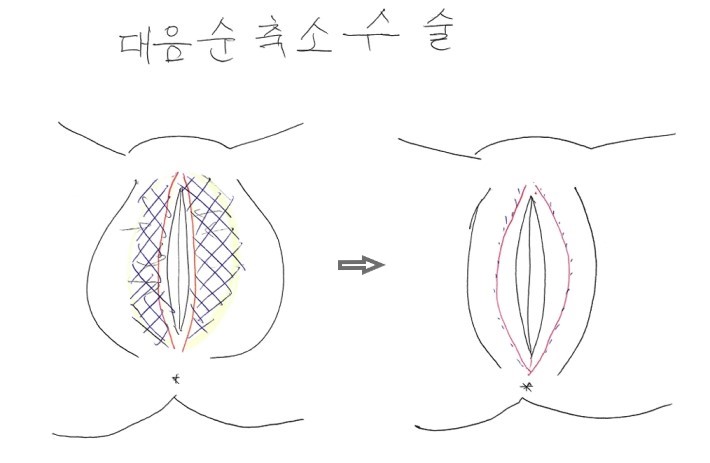
While preserving as much normal skin as possible,
the areas responsible for itching were carefully identified and precisely designed for surgical removal.
Labia majora reduction surgery is typically performed by placing the incision line
along the natural groove between the labia minora and labia majora.
Depending on the condition of the skin,
the thinner side of the tissue may be positioned slightly outward during closure.
However, in cases like this patient—where itching is severe and skin damage is extensive—
complete excision of the problematic tissue often results in better recovery and higher satisfaction.
When the patient returned for follow-up one month after surgery,
she expressed her gratitude, saying,
“I can finally sleep well at night now that the constant itching is gone,”
and smiled brightly.
Labia majora reduction surgery may be considered in cases of:
· Chronic itching
· Skin lichenification or eczema
· Significant labia majora hypertrophy
▶ When healthy tissue is carefully preserved and the procedure is completed with meticulous suturing,
recovery tends to be faster and patient satisfaction is high.
Compared to groin incisions,
this approach typically results in less scarring and quicker recovery.
In cases with significant lower tissue laxity,
a natural lifting effect may also be expected.
We hope that this patient’s case may be helpful
to those who have been struggling with similar symptoms for a long time.
[ A Note from Director Kim Min-kyoung ] Whenever I hear how long patients have endured itching and discomfort on their own, my heart feels heavy.
Labia majora reduction surgery is not simply a cosmetic procedure to change appearance. I see it as a process of restoring damaged skin and reclaiming everyday comfort.
After surgery, when a patient said, “Doctor, I can finally sleep well at night now,” those simple words stayed with me for a long time.
For the moments that may have been silent and painful concerns for someone, we at Gangnam DAUM sincerely hope that life can now feel a little less painful and a lot more comfortable. |
